What You Gain in Compression, You Lose in Nuance
On how headline compression happens
A few months ago, Business Insider published a short profile on me. It felt good, as recognition usually does.
What I want to reflect on today, though, is my first real experience watching the press construct a narrative of its own.
The current title of the article is:
I quit college at 21 to run my AI company. Sacrifices like working up to 80-hour weeks were worth it.
While yes, this is true… here was the original title.
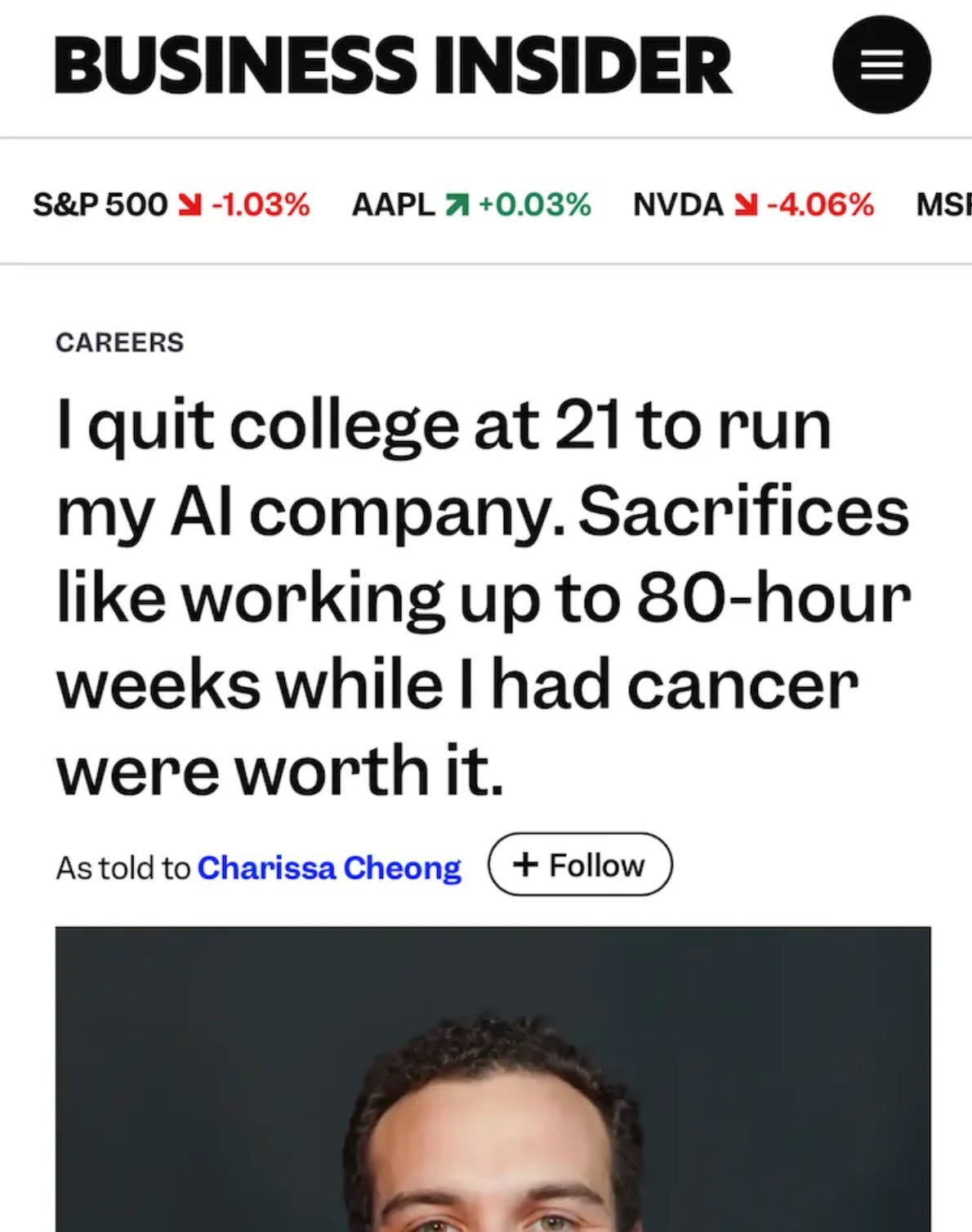
Just one minor detail, I never said this.
And the first-person narrative (written by the reporter) makes the title come across as a direct quote. How did this happen?
The small print under the headline image writes: "The following has been edited for length and clarity," which is another way of saying: "We're going to write our own story."
I looked at the transcript and found a few statements that were sorta similar to the quote.
I said (from transcript):
Well, when I initially dropped out I had somewhere in the range of like a little over $10k in savings from internships… so I spent that all to start Intros AI the first eight months… then from there I was paying myself 60k [eventually $80k after we raised $1M and $100k after we raised $2M]… and then now is the first time I don't have to like think paycheck to paycheck. It's just a whole different mindset. So it feels great knowing that it was all worth it…
And then like 30 minutes later in the interview the reporter asked:
"I mean what what was it like for for the cancer to be stage four at the point of diagnosis? What was receiving that news like and I guess yeah how did that then change all of your plans."
Then I replied (from transcript):
"I had some weird liver complications during the process. So I had a bunch of steroids. Because of that, I got somewhere around five hours of sleep a night, sometimes a little bit more… so the short of it is I was still working between 60 and 80 hour weeks even during that time period… I mean I didn't really have a choice I was like, I promise these people I was, I put my whole life into this and, you know, I made a commitment that this was going to happen. So, I needed to follow through…
So a statement about:
- Me paying myself the least amount I could for the sake of the company and then eventually getting out of that…
- And a separate conversation of me discussing how I was on these drugs + worked 60-80 hr weeks during chemo because of my commitment to the company…
Came together in a nice title:
"Sacrifices like working up to 80-hour weeks while I had cancer were worth it."
And that, is how we end up with media creating reality.
Why they changed the title & the icky feeling:
To be clear, I'm honored and feel lucky that they wrote a story on me.
Although when I initially saw the title I thought: "I never said that" and then I thought: "This feels icky, and I don't know why."
So, I did what I always do when something feels off and I don't know why: write and talk to friends about it.
We landed on five reasons for why "Sacrificed like working up to 80 hour weeks while I had cancer were worth it" felt icky.
Since the title doesn't say what "it" is (and the larger context is that I sold my company) the title implies that the ends of successful entrepreneurial journey justifies the means of having / working during cancer.
I told the reporter that "I would (in a heart beat) trade the company for good health." But that wasn't something worth highlighting in their eyes.
The title misses the nuance on how the drugs I was on enabled me to work during cancer.
[Mentioned above] In the transcript with the reporter: "I had some weird liver complications during the process. So I had a bunch of steroids. Because of that, I got somewhere around five hours of sleep a night, sometimes a little bit more." Since I was more awake + wired during this time, the drugs made it much more feasible for me to work long hours.
Without sharing the nuance on how drugs were a big part of why I was able to work AND saying that I was able to work 60-80 hour weeks, it downplays the seriousness of cancer.
I was lucky because:
- I'm young.
- I had the best possible health and emotional support.
- I had one of the least bad cancers.
- I didn't get sick during the chemo. If I got like a fever or even a cold during the process, it could have put me in a very dangerous place.
Just highlighting an outlier case where someone could work 60-80 hours during cancer, paints cancer as something you can just brute force your way through. Without the drugs there is no chance I could have put in the same amount of time.
If cancer is painted as something you can brute force your way through, then imagine how it would feel to be a 15 year old with terminal cancer completely outside of your control.
People are celebrating this 26 yr old for getting through cancer and here you are barely able to move. Terrible.
The title is a symbol of toxic "hustle culture" where we prioritize work above our health.
Generally speaking, I like hustle culture. It's important to work hard if you feel like you're working on something important or you want to reach your own potential. People should try to work harder if they can.
That is a VERY different than saying hard work is more important than health, especially in life-threatening scenarios. The message of toxic hustle culture is not the message I want to share with the world.
Now, thankfully this reporter is human and after raising these concerns to her, replied: "We'll change the headline, to preserve the accuracy of your sentiment."
Not everyone has a cancer card to pull, don't believe everything you read online!